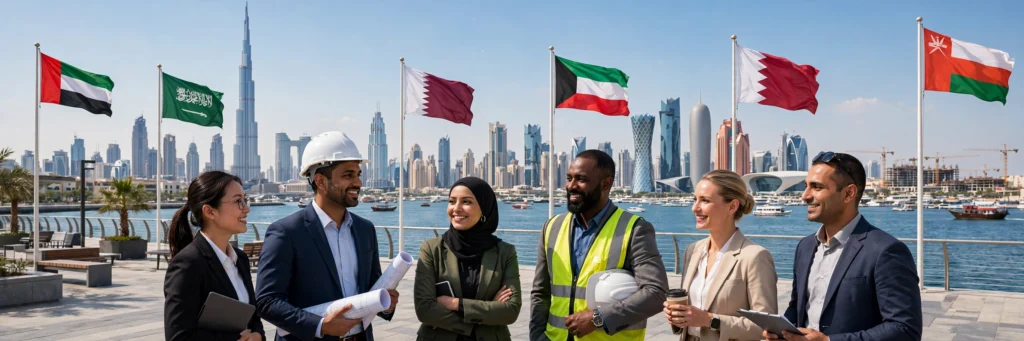

The Gulf Cooperation Council (GCC) countries — UAE, Saudi Arabia, Qatar, Oman, Bahrain, and Kuwait — remain the top overseas job destination for Pakistani workers. Millions of Pakistanis already work there, and demand keeps growing in construction, healthcare, hospitality, transport, and technology. This guide covers everything you need to work in the Gulf legally and safely in 2026.
Why the Gulf Still Works for Pakistanis
- Tax-free salaries in most GCC states — you keep what you earn
- Massive Pakistani diaspora — community support in every major Gulf city
- Low entry barriers — many roles need experience and a trade, not a degree
- Employer-covered basics — accommodation, transport, and medical insurance are standard in most contracts
The Six GCC Countries at a Glance
| Country | Key Sectors Hiring Pakistanis | Notes |
|---|---|---|
| UAE (Dubai/Abu Dhabi) | Hospitality, drivers, retail, IT, finance | Most diverse job market |
| Saudi Arabia | Construction, technicians, drivers, healthcare | Largest market; strict documentation |
| Qatar | Construction, energy, drivers, healthcare, teaching | Strong demand; Qatar Visa Center process |
| Oman | Construction, hospitality, retail | Smaller but steady market |
| Bahrain | Retail, hospitality, services | Compact market |
| Kuwait | Oil & services, domestic sectors | Strict 180-day residence rules for expats |
In-Demand Job Categories Across the Gulf (2026)
- Construction & skilled trades — masons, electricians, plumbers, welders, steel fixers
- Drivers — taxi, delivery, heavy vehicle (valid Gulf-region license usually required)
- Hospitality & retail — hotel staff, waiters, sales associates, cashiers
- Healthcare — nurses, technicians (licensing required in each country)
- Security guards — always in demand; basic English + clean record
- Technicians — AC, electrical, mechanical (skill verification increasingly required)
- IT & professional roles — developers, accountants, digital marketers
How to Find Gulf Jobs from Pakistan
1. Government Channels (Safest)
- OEC (Overseas Employment Corporation) — official government body with employer quotas
- BEOE-licensed Overseas Employment Promoters — always verify the license number on the BEOE website
2. Job Portals
- Bayt.com, Naukrigulf, GulfTalent, LinkedIn, Indeed (country-specific sites)
3. Direct Employer Applications
Large Gulf employers (airlines, oil companies, hospitality groups, construction giants) list openings on their own career pages.
The Standard Gulf Recruitment Process
The process is nearly identical across all six GCC countries:
- Job offer — you receive a written offer letter from a licensed employer
- Work permit — the employer applies to their government (this happens inside the Gulf country)
- Visa authorization — an authorization number is issued for your home-country application
- Medical test — at a GAMCA/Wafid-approved center in Pakistan (blood tests, chest X-ray, fitness screening). Failing means visa rejection.
- Documents — passport (6+ months validity), CNIC, police clearance, attested certificates
- Protector of Emigrants — register with BEOE before departure (mandatory for Pakistanis)
- Visa stamping — visa stamped on your passport
- Travel & residency — arrival medical, biometrics, then residency permit (Iqama or equivalent)
Skill Verification: The 2026 Requirement to Know
Gulf employers increasingly distrust unverified local certificates. For Saudi Arabia, the Skill Verification Program (SVP) runs through Pakistan’s NAVTTC in partnership with Saudi Takamol: you take a practical skill test in Pakistan and receive an internationally recognized certificate before your visa is issued. Skilled workers (electricians, welders, plumbers, AC technicians) should complete verification early — it directly affects hiring.
Protecting Yourself from Fraud
- Never pay large advance “visa fees” to agents — Gulf employers sponsor legitimate work visas
- Every overseas recruiter must hold a valid BEOE license — verify it yourself
- Get everything in writing: salary, accommodation, working hours, contract duration
- Never travel on a tourist visa expecting to “find work there” — you need an employer-sponsored work visa
Frequently Asked Questions
Q: Which Gulf country is best for Pakistanis in 2026?
A: It depends on your trade. Saudi Arabia has the largest volume of jobs; the UAE has the most diverse market; Qatar pays well in construction and energy. All six are viable through legal channels.
Q: Can I work in the Gulf on a tourist visa?
A: No. The unified GCC tourist visa (and each country’s visit visa) strictly prohibits employment. You need an employer-sponsored work visa.
Q: What is the Protector of Emigrants?
A: A mandatory BEOE registration for Pakistani workers going abroad. Complete it before departure — it protects your legal rights as an overseas worker.
Q: How much does the Gulf visa process cost the worker?
A: Legitimate costs you may bear: medical test (typically PKR 20,000–30,000), police certificate (PKR 1,000–2,000), document attestation, and travel. The employer’s government visa fees are normally the employer’s responsibility.
—
Sources:
- https://medium.com/@teleportmanpower/navigating-visa-requirements-for-overseas-employment-in-gcc-countries-2ecca6f4932b
- https://hcmglobalgroup.com/pakistani-trade-certification-gulf-recognition-2026/
- https://luna.com.pk/blog/unified-gcc-tourist-visa/
- https://falishamanpower1.mystrikingly.com/blog/jobs-in-gulf-countries-visa-requirements-and-application-process